
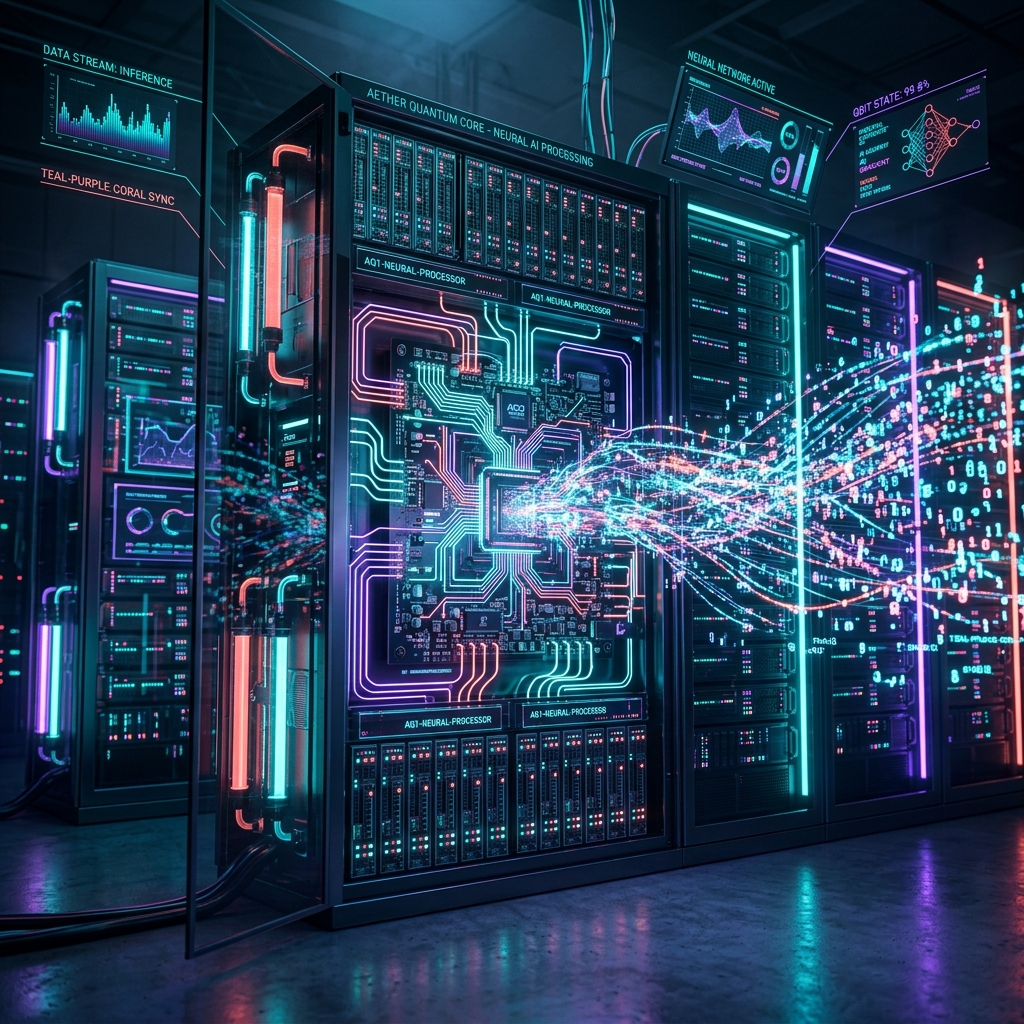
Agentic AI applications require complex reasoning loops that can execute in milliseconds. Standard microprocessors are reaching their physical limitations. To build truly responsive on-device agents, we must look to quantum-inspired and neuromorphic hardware at the edge.
1. The Agentic Latency Challenge
An agentic workflow is not a single query-and-response. It involves planning, reasoning, executing tools, inspecting results, and refining strategies. If each step of this loop requires a round-trip to a cloud server, the total user-facing latency becomes unusable.
To make agents feel instantaneous, the loop must execute entirely on the user's device. This requires architectures that can process millions of high-dimensional matrix multiplications in parallel, without draining the battery or overheating the chassis.
"Subsecond latency is not a luxury; it is the line between a tool that feels like a software utility and one that feels like an extension of your own mind."
2. Quantum-Inspired Tensor Accelerators
While true room-temperature quantum computing at the edge is still in development, "quantum-inspired" tensor cores are already here. These specialized circuits use mathematical approximations of quantum superposition and entanglement to solve optimization and search problems in a fraction of the time required by classical GPUs.
By mapping prompt evaluation, token search, and multi-tool planning to these tensor arrays, edge devices can execute complex planning algorithms in parallel, selecting the optimal path in microseconds.
3. Neuromorphic Hardware Cores
Neuromorphic chips mimic the physical structure of biological neurons. Instead of constantly transferring data between memory and processing cores (the classic Von Neumann bottleneck), neuromorphic cores compute directly where the data lives.
This massive reduction in data transfer reduces energy consumption by orders of magnitude. A mobile phone equipped with neuromorphic cores can run complex AI model inference continuously in the background, acting as a true "always-on" cognitive companion.
Conclusion
The future of AI is local, agentic, and instantaneous. As quantum-inspired architectures and neuromorphic cores migrate into consumer devices, the cloud will transition from a primary compute engine to a sync and coordination layer. The true powerhouse of tomorrow will live silently in your pocket.